Teaching Mathematics Outside the Classroom
Number
There are a variety of ways of teaching number outside using lots of simple resources. They can be adapted to any strand unit such as counting, numeration, operations, place value and fractions. Through completing maths trails, children will recognise how relevant number is in our environment. Similarly it gives the children an opportunity to discuss mathematical findings with each other.
Maths trail. For this activity children need clipboards and a worksheet. Set up a maths trail around the school where children will have to answer a variety of questions. An example of this would be to write down the number of square shapes they saw in the playground or count the number of windows in the school building.
A maths trail can be used for any topic in Number. Skills include applying, problem-solving, integrating, reasoning, implementing, understanding, recalling and communicating using mathematical language.


What number? Place foam numbers randomly across the playground. Call out a range of numbers. Children run and stand on the number that is called. They are learning to identify a variety of numbers.
Odds and Evens. Call out either the word odd or even. Children run and stand on an odd number if you say odd or an even number if you say even. The are learning to recognise odd and even numbers.
Sequence. Have a few sets of numbers 0-20. Put children into groups of 5. Children to place numbers in order across the playground from biggest to smallest and smallest to biggest.
Jumping on/back. Call out a variety of addition sums. Children physically jump up/down a large number line in the playground to find the answer.
Groups. Stand on a foam number. Children run to get into groups of that amount. Repeat standing on a different foam number.
To differentiate - increase number size and difficulty of questions.
Foam Numbers
Maths Trail
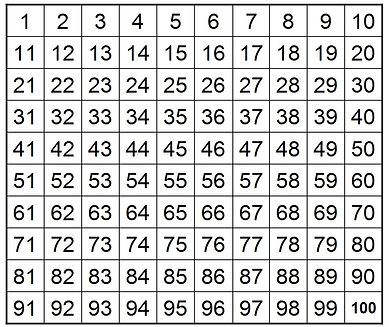
100 square
Jumping on/back. Ask a variety of addition and subtraction questions for example 6 + 5. Using a large 100 square children
physically jump on/back and stand on answers. This activity can be completed in the gym or on the playground.
Counting. Children learn to count in 2's, 3's, 4's, 5's and 10's. They jump on in various intervals on the large 100 square in the playground.
Tens and units. Using a large 100 square, ask children to stand on a number with 2 tens. Ask them to stand on a number with 9 units. This is an active way of teaching place value.
Odds/evens. Call out either word odd or even. Children jump to an odd number or an even number on the large 100 square.
Adding/subtraction tricks. Add 10/take away 10. Children jump up or down one space and show answer on the large 100 square. Add 20/30, using trick of jumping down for addition or jumping up for subtraction.
Hula Hoops
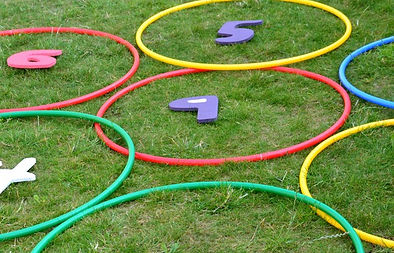
How many? Children stand behind each other in groups of 5. Place 3 hula hoops varying distances away from children. Child aims to get the bean bag into hula hoop. If they get the bean bag in the closest hoop they get 1 point. Older children: Increase value of points for example they get 2 points for the closest hoop, 3 points for the middle hoop and 5 points for the furthest hoop.
Making Questions. Place three hula hoops in a row. Children need 3 laminated sheets with + on one, - on another and = on the last one. Place a number of bean beags between 0-20 into two of the hula hoops. Children devise question with the two numbers and solve the answer. For example 9 - 5 = 4 or 6 + 14 = 20.
Greater than/less than. Place a certain number of bean bags into two hula hoops. Children recognise which hula hoop has more/less. Use laminated sheets with < on one and > on the other. Children to place correct symbol between hula hoops.
Simple Division. Give each child a set of bean bags and ask them to divide them between 2/3/4/5 hoops. For example give a child 12 bean bags and 3 hula hoops. Ask child to share them equally between the hula hoops to see how many bean bags each hula hoops gets.